Nothing is usual anymore : Gabriel Barcia Colombo in conversation with Fine Acts
”Business as Usual” is a solo exhibition by Gabriel Barcia-Colombo, created with the support of Fine Acts, currently on view at C24 Gallery in New York City. Exploring disconnection, pseudoscience, and technology, the exhibition examines human responses to a world increasingly shaped by machine progress and experience. Engaging with metaphors of migration and the chaos of contemporary existence, Business as Usual considers motion without progress, ritualized behavior, and questions of escape. Barcia-Colombo interrogates how we conduct or go about our "business" and whether we should even conduct "business" at a moment when humanity seems out of balance.
We sat down with the artist for a conversation on the work and the ideas behind it.
“I think the exhibition is a mirror, but like a weird funhouse mirror that’s showing us a part of ourselves in a way that might enhance these parts of society, but then also raise some questions.”
〰️
〰️
Fine Acts: Why ‘business as usual’?
Gabriel Barcia-Colombo: Business as Usual is kind of a sarcastic title. Because it’s about this time that we’re in, where nothing is usual anymore. We have wars happening across the world, climate change, issues of immigration. Especially in the United States, there are all these things going on, and yet we present that things are normal a lot of the time, especially online, where we’re going about our normal day, sharing what we ate for breakfast next to what is happening in the Middle East.
It’s a time where everything has been flattened, where all the information has been flattened, and I think that’s very interesting and also very dangerous, that we flatten everything into having equal value in a way online.
That’s what the show is about – examining this weird time that we live in, examining what it means to conduct “business” at all at this point, and thinking about whether anything should be usual right now or not. It’s told through these images and sculptures in the show that are normal everyday things. You have a subway car, you have an escalator, you have these little road signs, things that you might see around a city like New York, and I’m using them as these vessels or containers to make statements about bigger concepts: immigration, progress, the pandemic, artificial intelligence.
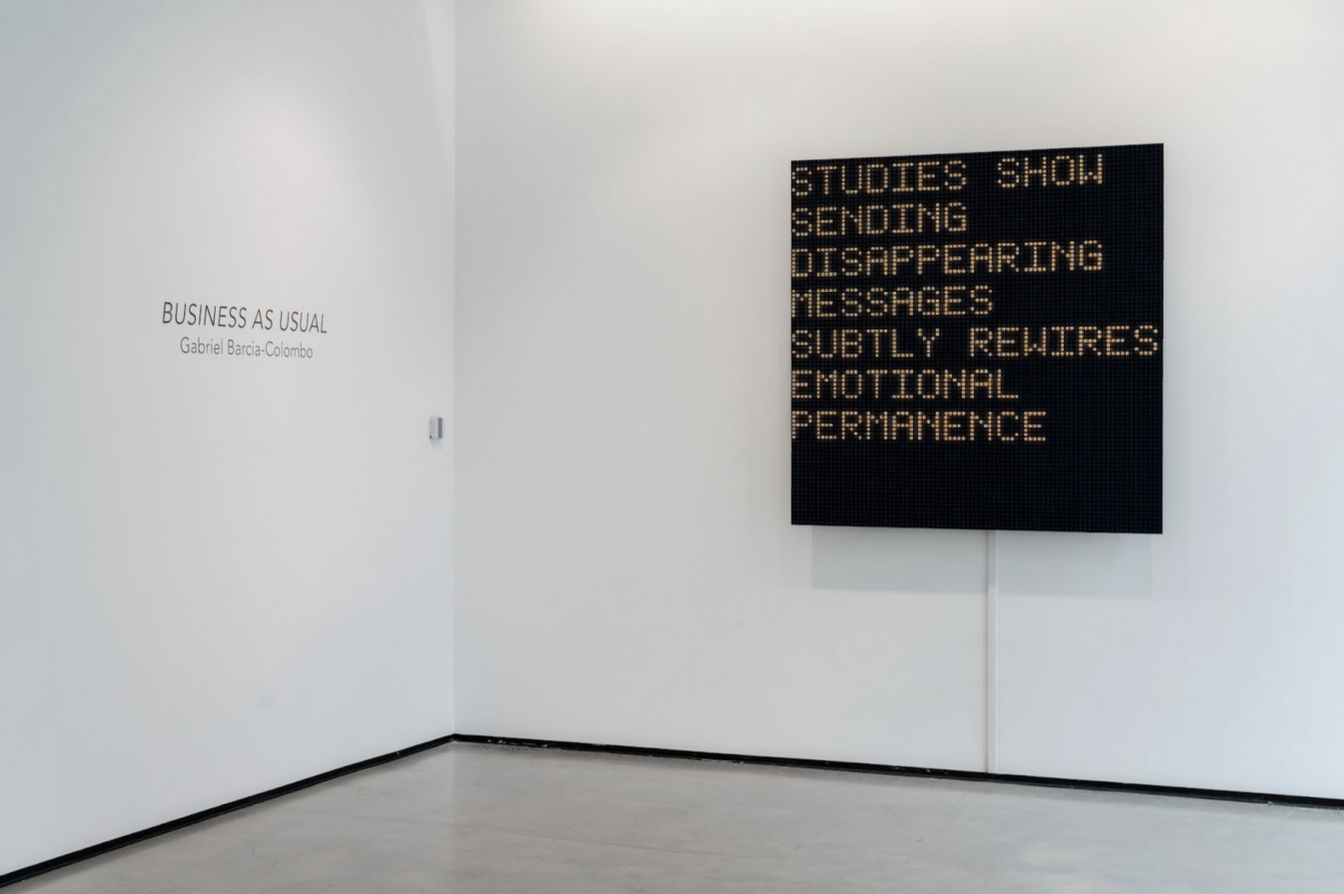
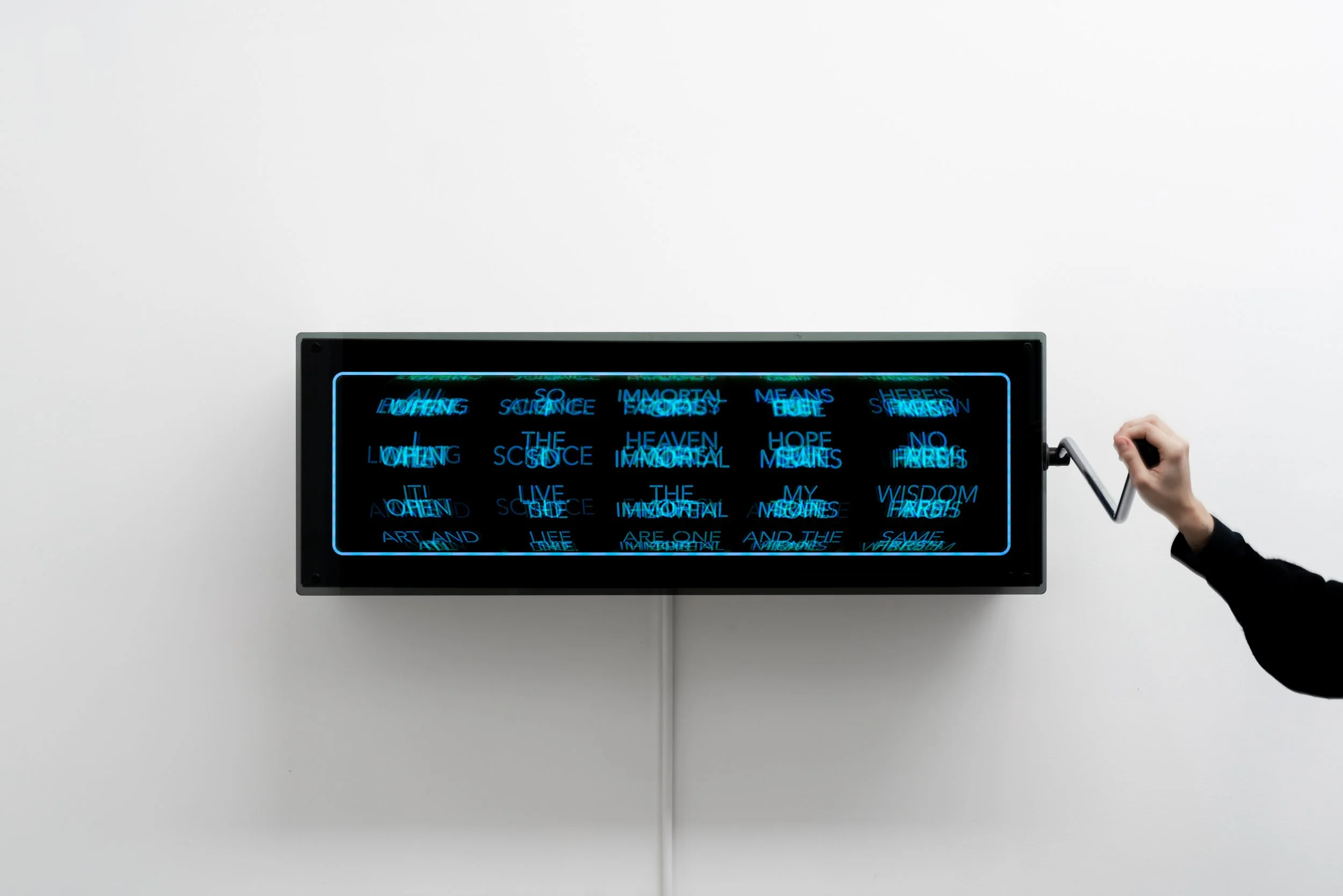
“The first piece you see when you walk in is a big LED sign that looks like a street sign you’d see on the side of a road or highway. It has this big phrase on it: “Studies show.”
Different statements appear on the sign – things like “studies show the world ends in delayed notifications”, “studies show men who own cats are 38% more emotionally available”. They seem like they could be true, but they’re actually completely generated by AI, based on the kinds of “studies” I found on Instagram.
I started noticing all these posts – some silly, like “wearing socks to bed improves your sleep,” and others more serious, like “this pill will prolong your life” or “eating a hot dog reduces your lifespan by five years.” There’s often no real source behind them. They’re just things people put online for likes, and yet we start to shape our lives around them.
That pseudoscience felt really interesting to me. People want information, and they’re willing to click on anything to get it. So I created these “studies” pieces – one large LED screen and three smaller road-sign versions. They’re constantly generating new statements across categories like religion, culture, relationships, health, and technology.”
FA: Do you see this exhibition as more cautionary, speculative, or observational? Is it a warning, or a prophecy?
GBC: I think I see it as a warning and also as a documentation of a period of time. To me, it’s a reflection more than anything else, but it’s a reflection through different lenses.
I am taking a symbol or an image and then extrapolating that into a larger reflection on some part of our society – like, an escalator, as a metaphor for migration.
So I think it’s a mirror, but like a weird funhouse mirror that’s showing us a part of ourselves in a way that might enhance these parts of society, but then also raise some questions from that as well.
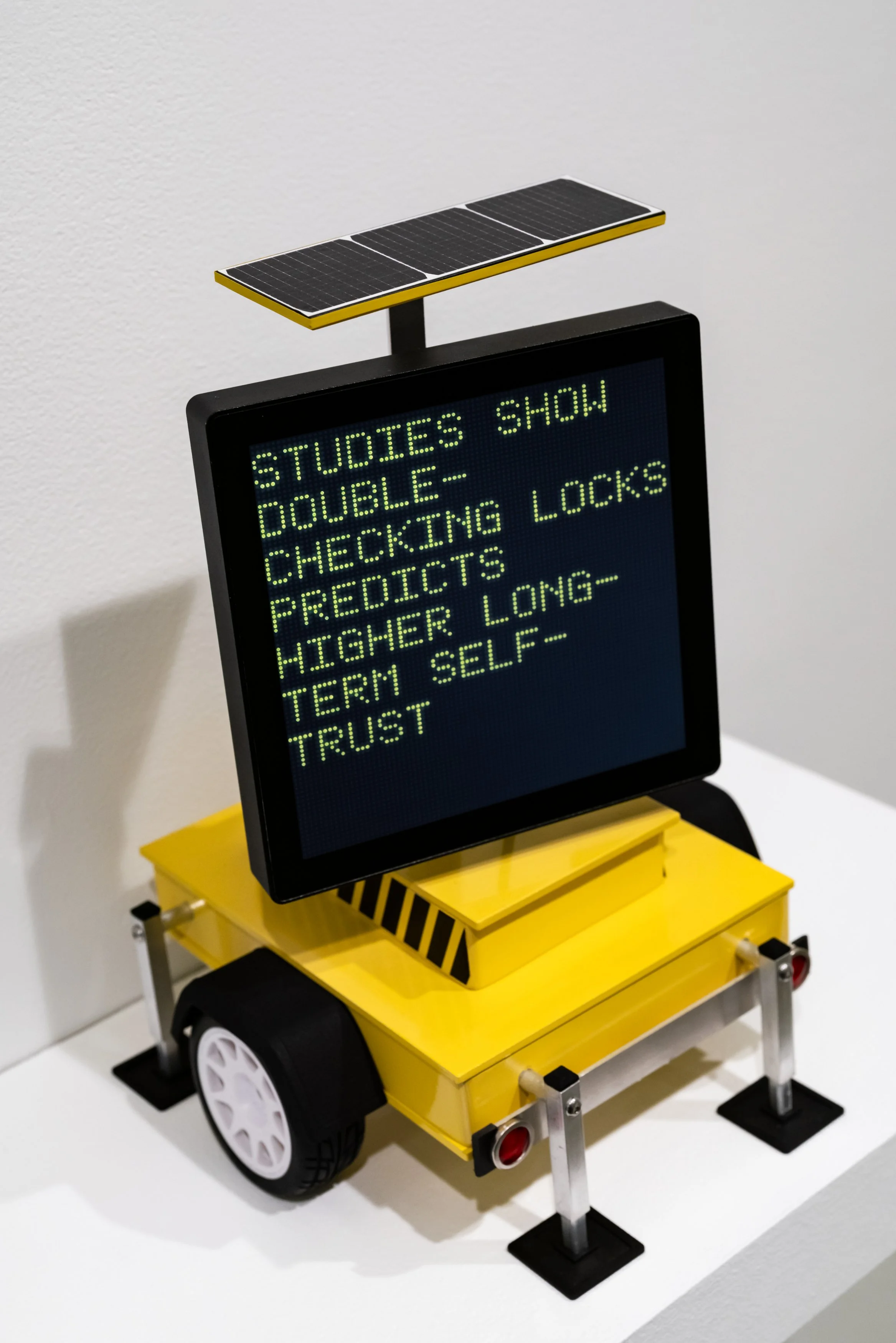
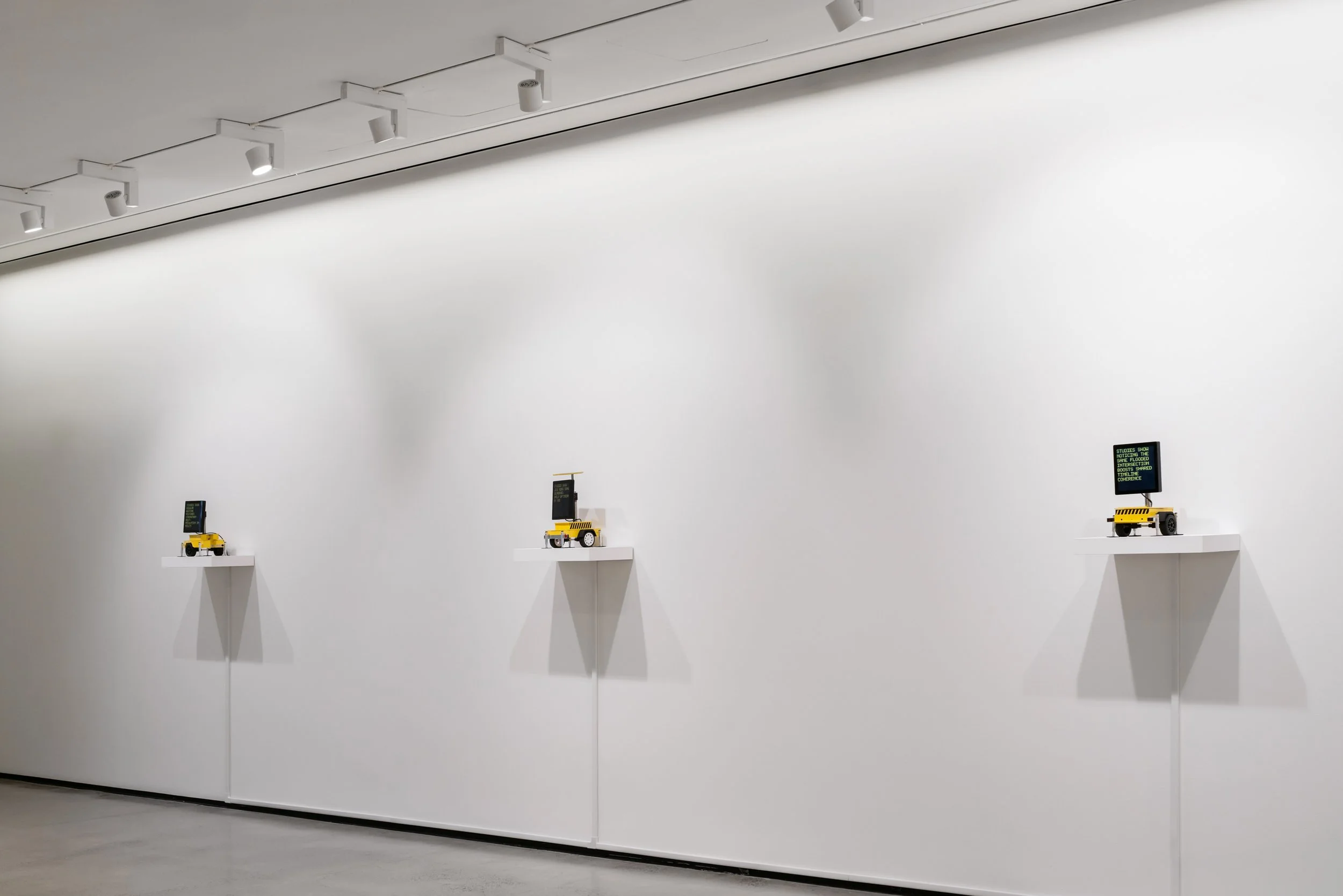
“The writing process was also important. I wasn’t just letting ChatGPT generate everything – I was working with it, editing, reshaping, and prompting again. It became a kind of collage process.”
FA: The show references disconnection, and pseudoscience. What connections do you see between these two phenomena?
GBC: I think technology and pseudoscience are directly connected, and also our sort of thirst for never-ending knowledge. There’s a short story from 1909 called The Machine Stops by EM Forster, which I teach in my classes at NYU. It’s a very old story but it’s about a society that becomes addicted to a machine, which is crazy for the 1900s – it was written around the Industrial Revolution.
In it, these people have a society that’s all about exchanging knowledge, and they kind of lose their humanity because all they do is exchange thoughts back and forth all the time.
Today, people want to share things, and people want to talk, and sometimes it’s sexier to have a new piece of information than it is to have a true piece of information. And I think that’s really dangerous. It’s very dangerous for our world, and it leads to all sorts of problems that we’re experiencing now, where we have people in power that don’t know what they’re doing.
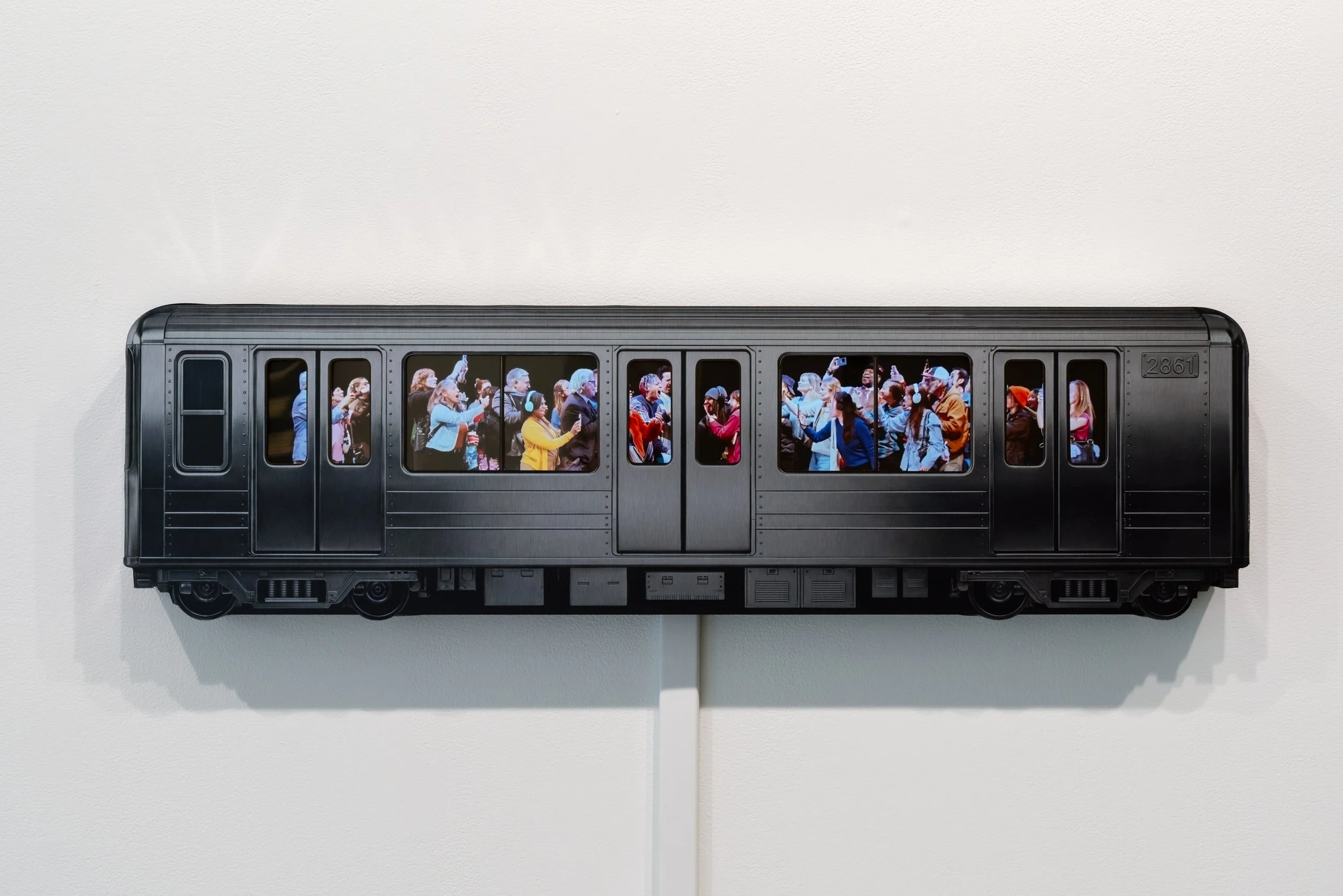
“Commuters is a small, two-dimensional metal subway car mounted on the wall, modeled after a New York City train. Inside, there are 40 New Yorkers on video, shown across a long screen embedded in the piece.
At first, it feels like a normal commute. People appear in the windows as if they’re going about their day. But then something shifts, and a kind of confrontation begins to unfold. It becomes this strange choreography – almost like a ballet – where people move to opposite sides, watch each other, and try to reposition themselves.
There’s a moment where both sides start taking photos of each other, like what you see in protests now, where the phone becomes the weapon. It reduces people to images rather than who they are.
To me, it’s about the pandemic, about traveling in a city, about learning how to be around each other again. It’s also about how divided we’ve become through culture and technology. The piece is about 22 minutes long and was filmed in a single take with all 40 people on a soundstage.”
FA: Talking about disconnection, the exhibition mentions connectivity as the ultimate form of resistance – can you expand on what that means to you?
GBC: During the pandemic, we lost connection with who we are as people a little bit. We lost our connection to humanity. You can’t go through that kind of event and then suddenly pretend it didn’t happen. And I think we never had the proper re-entry into society. We were just told one day to go back to work, and it was like this collective nightmare / dream that never happened. And I think we’re losing it (humanity) more and more.
The whole point of the internet and capitalism is to divide us in a way to enrich other people. That’s what’s happening. So when you find moments of connection, it’s beautiful. It’s the most important thing in the world, I think, how to connect with people.
For me, it’s finding connection through art, or through teaching, or through meeting with people and mentoring people. But I think a lot of folks don’t have a venue for that anymore, and they instead fall further into their own little worlds, whether that’s social media, video gaming, or television and the internet.
Especially with younger generations, I see that they have such trouble connecting to each other, that human connection has almost become a luxury.
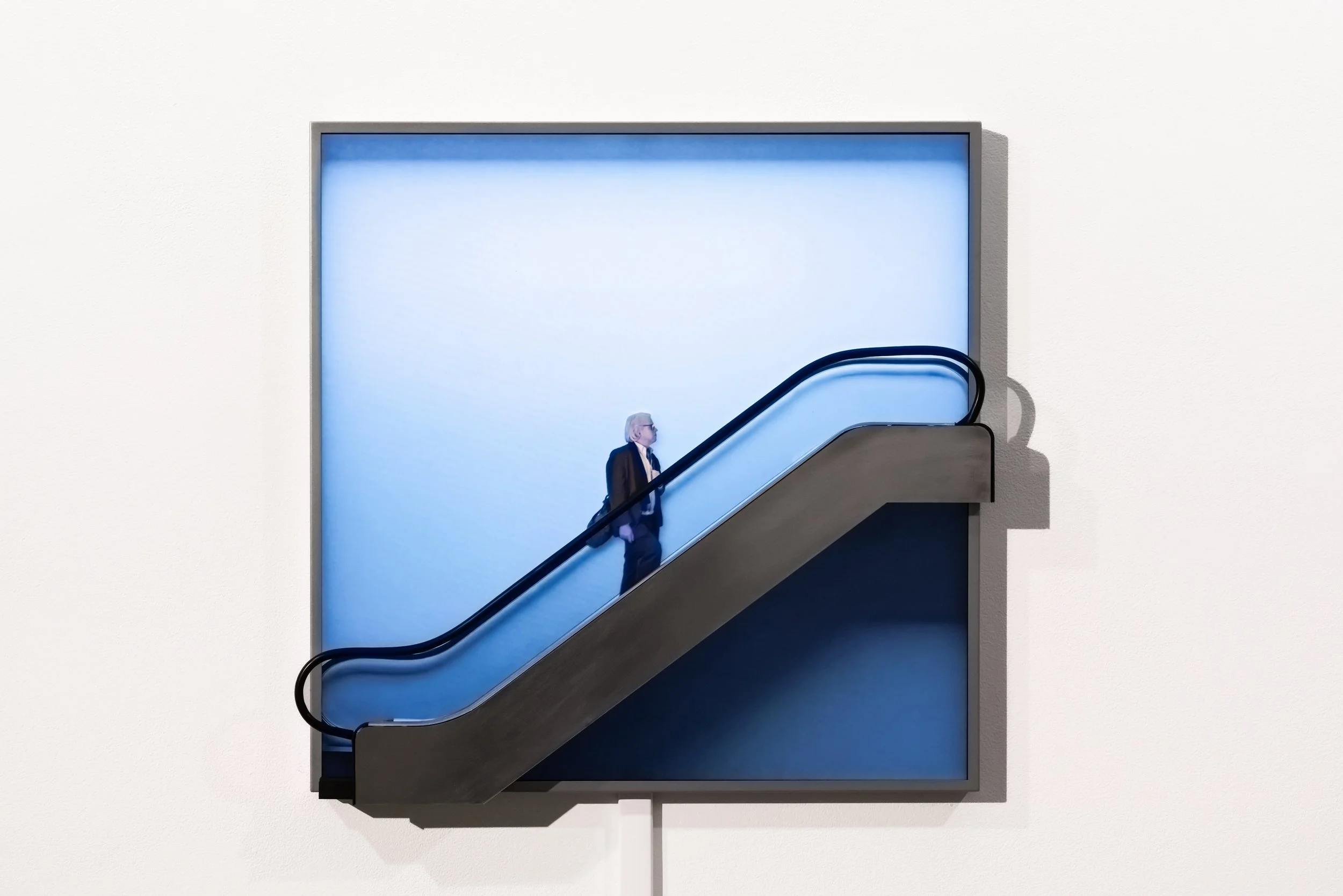
“Escalate is a small piece that shows people stepping onto an escalator, moving upward, and immediately stepping off – but it loops endlessly.
You start to notice the same people appearing again and again. As the piece continues, they carry more and more luggage, until they’re burdened with all their belongings. It raises questions – why are they trapped here? Where are they going? What are they escaping from?
The piece is about migration, movement, and also this idea of motion without progress. It has a treadmill-like feeling – like we’re constantly moving but not actually going anywhere. That feels very connected to how we experience technology now, where it feels like we’re moving, but toward what?
The figures become more anxious as the piece goes on, almost frightened. It’s unclear what’s happening, which is part of the tension.”
FA:What gives you hope right now in terms of human connection and collective experience?
GBC: I think what gives me hope is creativity. I think people making things and sharing things is always good, and that hasn’t gone away. I still see it with my students, and I see it online, that people really want to make things. They want to make things that reflect what’s going on in this world, and the more we can empower that, the more hope it gives me.
What doesn’t give me hope is the idea of people just commenting on things. There’s also a culture of feeling like you’ve accomplished something by commenting on it.
I’m hoping to transform more people into makers rather than commenters – that’s my goal. Even with this show, people ask, “How did you do this?” and “How did you do that?” A lot of artists wouldn’t respond or explain how they did it, but I say, “Here’s how I did it. You could go do this yourself if you want to.” It’s okay. I know the work is made by me, and people will know that, so if someone wants to make another video piece with a lot of people in it, they should go do that. I think that’s helpful to everybody.
Even with technical things, someone might ask, “How did you get a square screen?” and I’ll say, “Here’s how you do it. If you want, you can talk to this person I know who can make it.” That kind of gatekeeping doesn’t help you in the end, and someone will figure it out anyway. So why not just help them now, rather than a year from now when they’ve gone through a whole struggle to do it and end up kind of angry at you? It’s not really helpful.
To me, art is a conversation, and the conversation can’t be one way only.
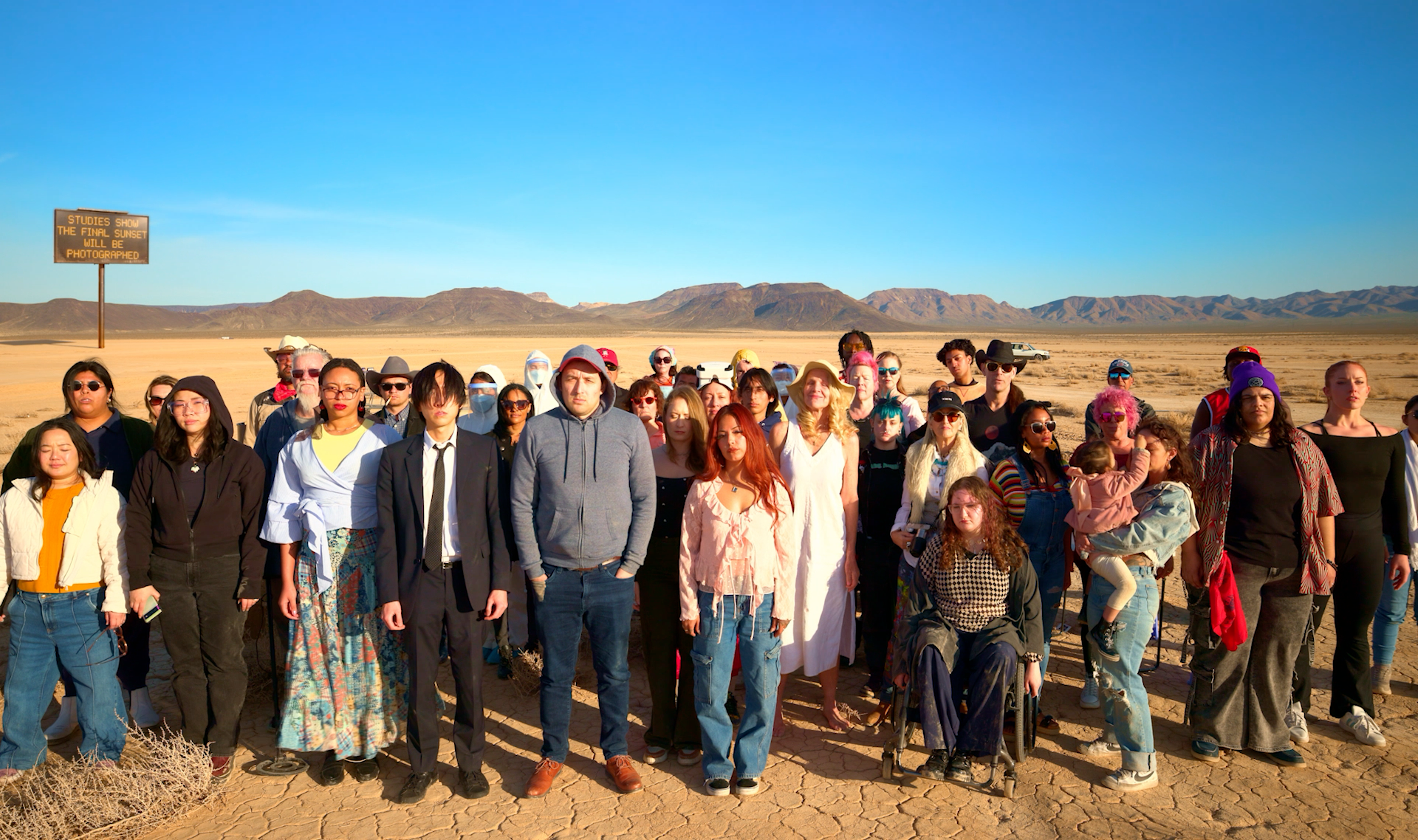
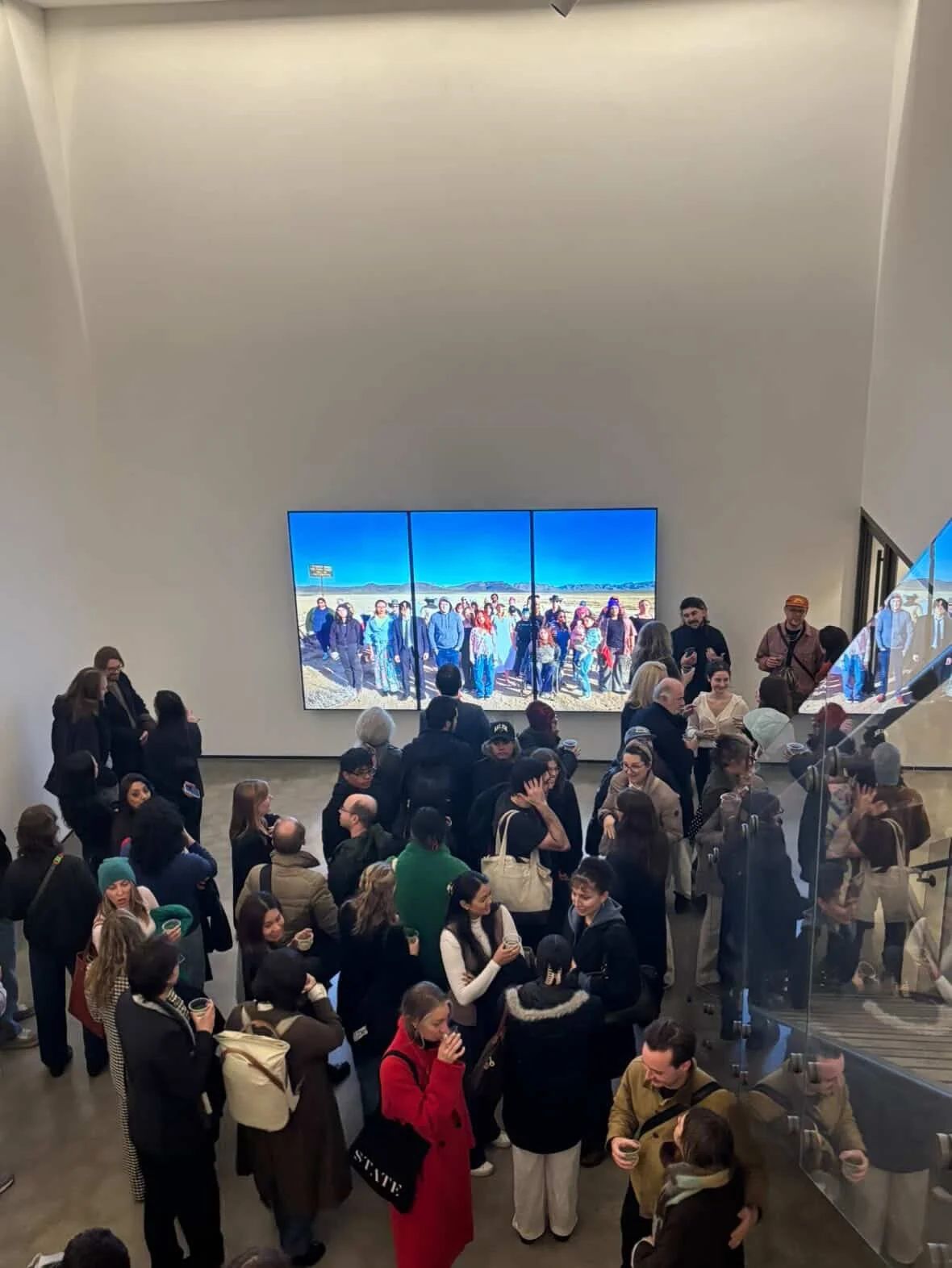
“After Party is a large-scale video piece which I filmed in the desert. It’s a very personal work. I spent about six weeks in Las Vegas in 2022, and I became fascinated by the city as a kind of testing ground for America.
Las Vegas is a city of simulation, and increasingly, that feels like a global condition – that you can get anything you want anywhere, but it all starts to feel the same.
After Party – as in, what does the after party of the end of the world look like? The piece is about a slow-motion apocalypse – an end of the world that continues as if nothing is wrong. I filmed it with 50 people in the desert, all real participants. People often assume it’s AI or composited, but it’s not.
The work is structured as a triptych. On one side, there’s a leisure and activity zone – people exercising, gambling, performing these behaviors you might see in an online feed. In the center, there are relationships: a couple on their phones who occasionally turn and kiss, people counting money, groups arguing in the background.”
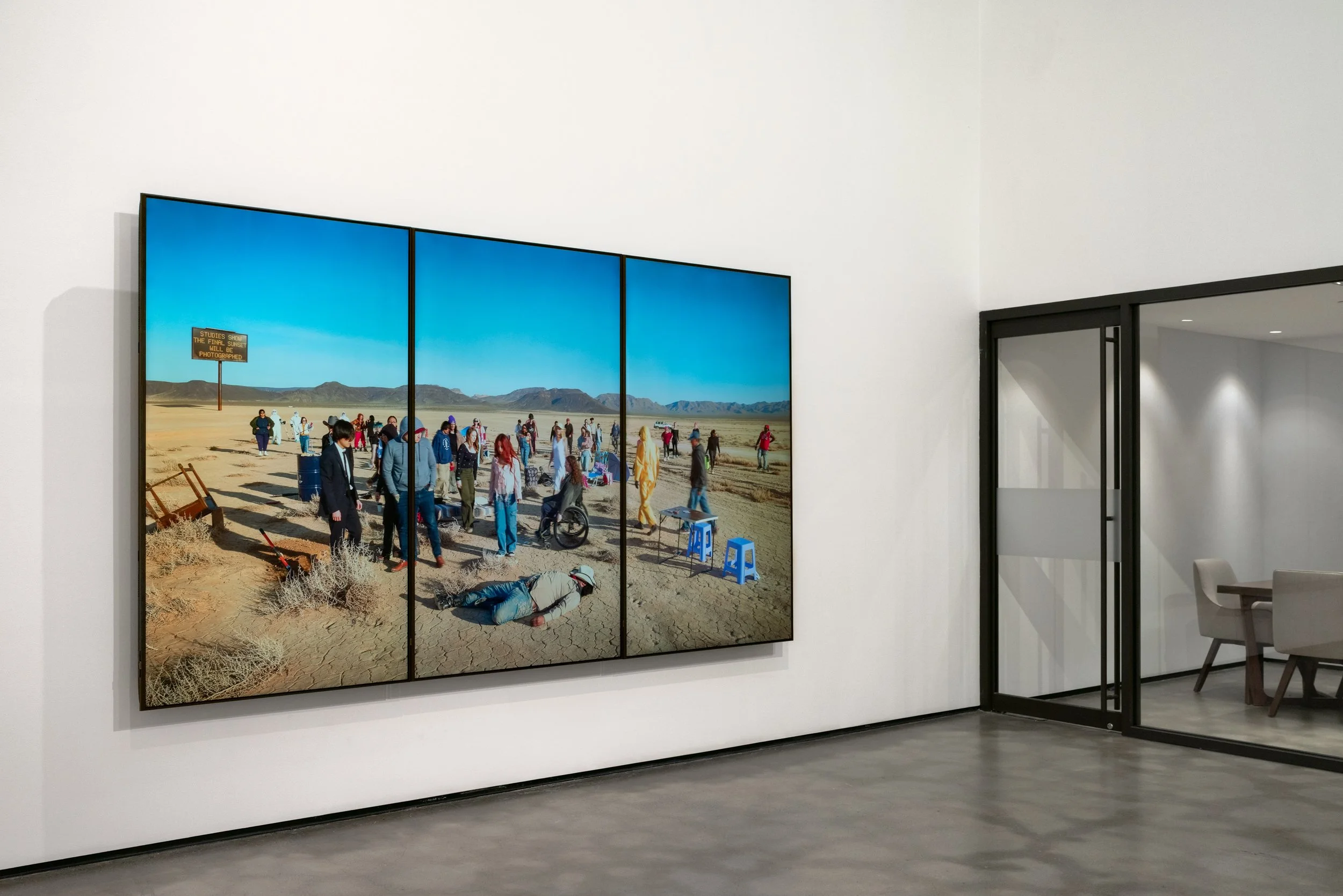
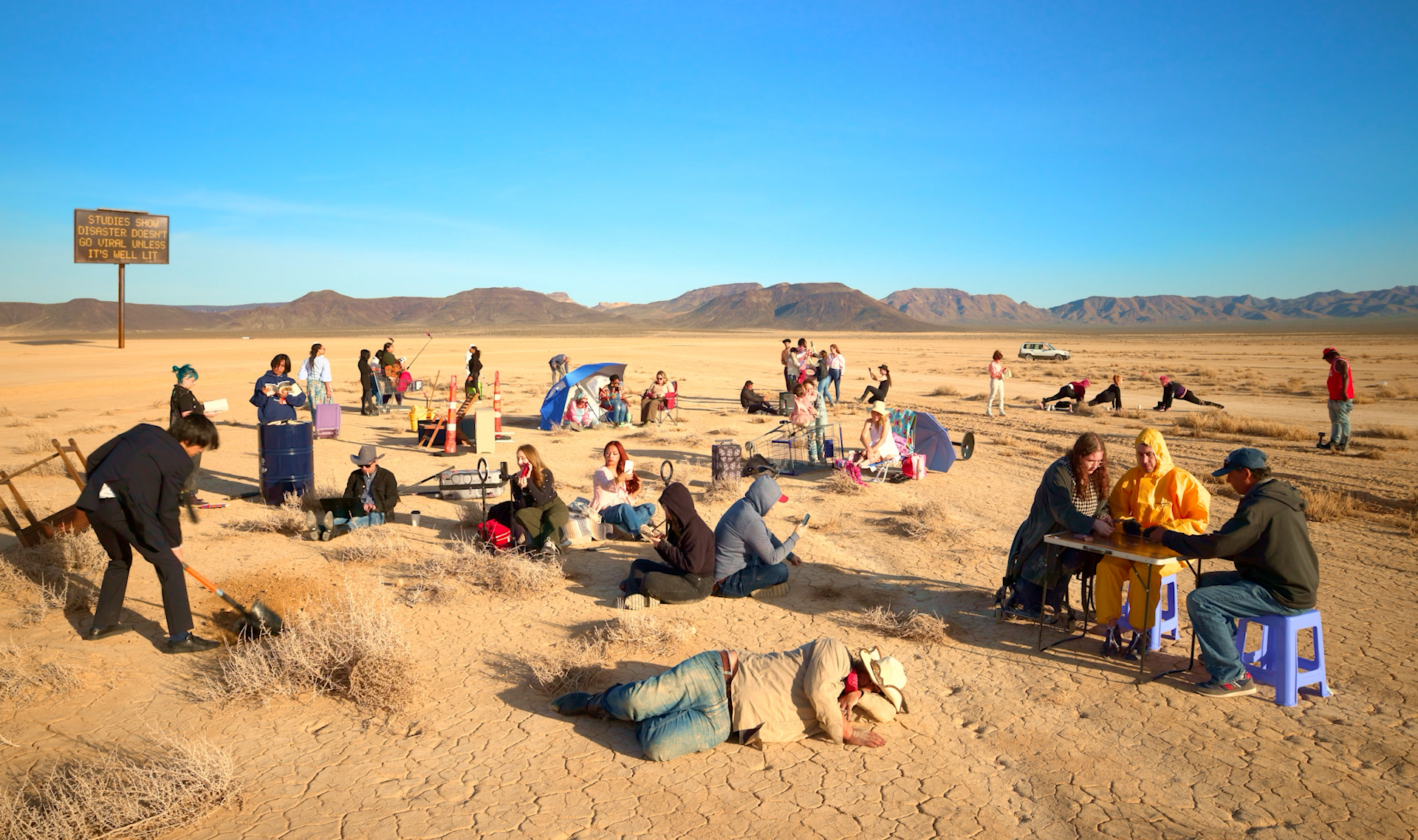
“On the other side is knowledge and its pursuit – people walking with selfie sticks, someone digging a hole endlessly, others preparing to burn a pile of books. There’s also a large sign, like the “Studies show” works, that functions almost like a religious symbol of the internet.
In the foreground, there’s a man lying on the ground, dressed like a cowboy. He moves slightly, but you’re not sure – Is this his dream? His nightmare? Is this the end of something, like the American dream?
At the end of the piece, everyone freezes, then walks toward the viewer and looks directly at them. It creates this moment where you realize you’re part of it – that you’re performing similar behaviors just by watching.
When the screen cuts to black, you see your own reflection. It wasn’t intentional, but it creates this realization: you’re in it too.”
FA: Your work can be playful or funny, but it’s dealing with heavy stuff – what does humor let you get at that a more serious tone wouldn’t?
GBC: Humor has been used forever as a way to poke fun at systems of power. Growing up, I loved that. I think, first of all, it’s just who I am. I’m a serious person, but I’m also a kind of strange, funny person. I have a playful nature that I think is really important.
So much art is very serious for the sake of being serious, and I understand people who make work about serious topics, but it’s just not who I am as a person.
I really think there’s a darkness in humor that can be used to express really big concepts. It’s a little bit like animation – people used to think it couldn’t be used to talk about serious ideas, and then you see something like Grave of the Fireflies, which is a really serious, powerful animation, and people are crying after they watch it. All these art forms can be used in different ways.
Putting restrictions on art is the worst thing you can do. For me, I use humor in a very subtle way. The signs in this show say things that are kind of funny. Some of the things you find online are funny too – some of these weird studies you come across make you think, what??? So I’m trying to exaggerate the reality to make a statement a lot of the time.
That’s why I use it. It’s an exaggeration, it’s an amplification.
“To me, art is a conversation, and the conversation can’t be one way only.”
FA: How do you personally navigate your own relationship with technology while critiquing it?
GBC: This show was pretty tricky technologically. I won’t lie – there were times where I was like, “ChatGPT, you have to help me. I’m stuck,” because I’m using things that are brand new, that haven’t really been used before in the show.
So it’s a weird relationship where I’m critiquing the thing that I’m also using. But to me, it really is just a tool. It’s no different than using a paintbrush, a computer mouse, a tablet, or even a pen. It’s just something that I use.
I’ve grown up in a way where my tools have always been technology. Ever since I was a kid, I was drawing on a Mac II computer, making video games on it, and then getting into video. Video, to me, is the perfect technology for my work because it’s about collecting memories, capturing moments in time, and storing them somewhere – digitizing them.
So yeah, it’s a love-hate relationship with technology.
FA: Art's role today, art's responsibility today – how do you see it? If technology's already shaping how we think, what can art still interrupt?
GBC: I think I have mixed feelings on this, because I don’t think we should be making rules for art at all. We shouldn’t say that art has a role in doing something, because then we start to guide art in a certain way, and I think art should be totally open all the time. Anybody should be able to make anything they want.
But I do think that if you are interested in reflecting on what’s happening in the world today, there’s no better place to do it than by making artwork.
And I hope that people make more artworks with people. There’s an interesting thing happening now where people are afraid to feature people in their artworks. I’ve noticed this in the past couple of years.
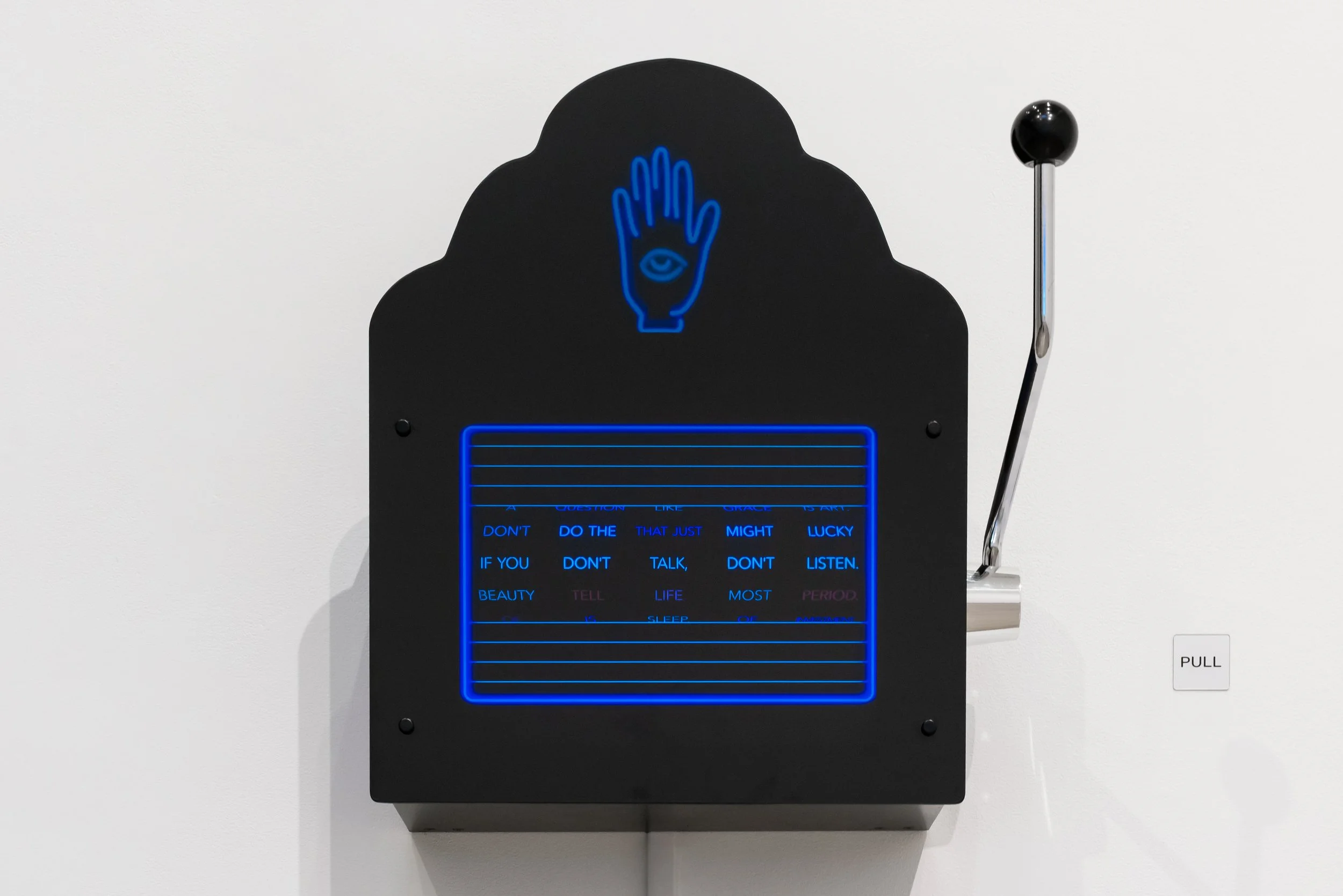
“The Holy Roller is a slot machine that generates a different phrase each time you pull it – something like a prophecy about your life.
It’s trained on religious texts, presidential speeches, and influencer quotes, so it produces this strange mix of advice and belief systems.
I made that piece in Las Vegas, watching people at slot machines, and then came back to New York and saw people on their phones on the subway doing something very similar – almost like praying to a device, hoping for something new.
Even with this show, I sometimes feel like I’m doing the same thing – checking reactions online, like pulling a slot machine. It’s like I’m trapped in my own piece in a way.”
FA: Why do you think that is?
GBC: I don’t know – I think it’s multiple things. At a very basic level, institutions are afraid of featuring people. They’re afraid of getting pushback from artwork that includes people, with questions like, “Why are these people chosen? Are you making a statement about these people?”
So it starts to put restrictions on the idea of representing humanity in your work, unless it’s very abstract. And I think it’s also what we were talking about – we’ve lost a little bit of our humanity, so people aren’t thinking about people anymore. They’re thinking about bright colors and shapes and forms.
It becomes a kind of abstraction of humanity, and that’s a little scary to me. I see a lot of shows in New York that are just shapes on canvases or sculptures of shapes, and I wonder what’s going on.
For me, the goal is to make work that pushes people’s buttons a little bit, that makes them reconsider something they hadn’t thought about before – even if it’s just the form of the artwork.
I told my students the other day that video art is an art form, and they were shocked that people buy and collect video art. They couldn’t even imagine it. And I said, this is 2026. They asked, “Couldn’t you just make a copy?” And I said, you could also make a copy of the Mona Lisa or any painting and hang it in your house.
There’s still a lot to be learned, and I hope that with this show, it expands people’s ideas – not just about the concepts, but about the forms too. That’s always the goal for me.
“I don’t think we should be making rules for art at all. Anybody should be able to make anything they want. But I do think that if you are interested in reflecting on what’s happening in the world today, there’s no better place to do it than by making artwork.”
Artwork Photos courtesy of Regina Urazayeva and Michelle Higa Fox.
〰️
〰️
About Gabriel:
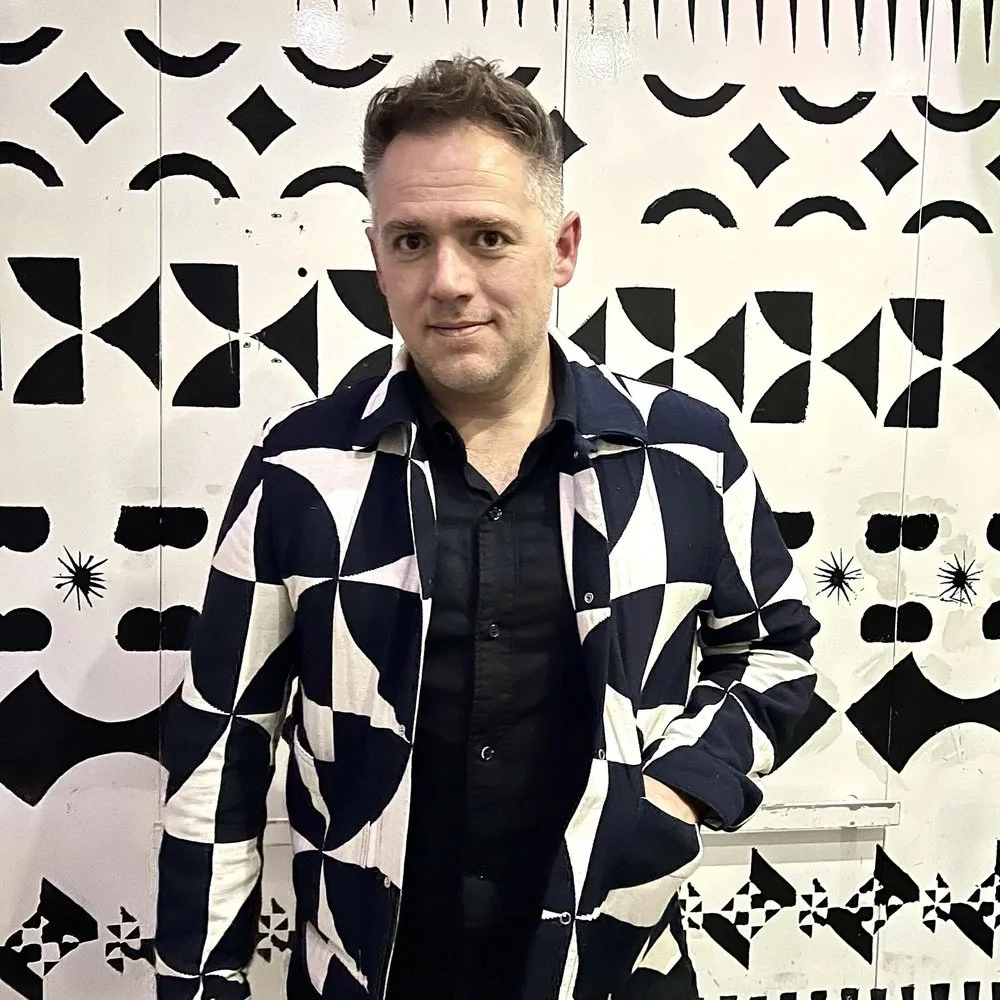
Gabriel Barcia-Colombo is a New York–based multimedia artist whose work explores themes of memory, technology, and collective experience. The artist often uses humor as he tackles serious issues in works of all sizes – from small sculptures to large-scale, interactive, public installations.
Gabriel’s work has been featured in the Volta, Scope, and Art Mrkt art fairs, the Victoria & Albert Museum, the Grand Central Terminal, and the New York Public Library. He received an Art and Technology grant from the Los Angeles County Museum of Art where he created ”The Hereafter Institute” – a company that questions the future of death rituals and memorials and their relationship to technology.
Gabriel served as a member of the artist advisory board at the New York Foundation for the Arts, as well as the education committee member at the Museum of Art and Design. In 2012 Gabriel gave a TED talk entitled "Capturing Memories in Video Art," and in 2014 he gave another entitled "My DNA Vending Machine" and was awarded a Senior TED fellowship.
In addition to his own practice, he is an Associate Professor at NYU's Tisch School of the Arts, where he teaches Interactive Media Arts and Interactive Telecommunications.