From noise to strategy: How movements win
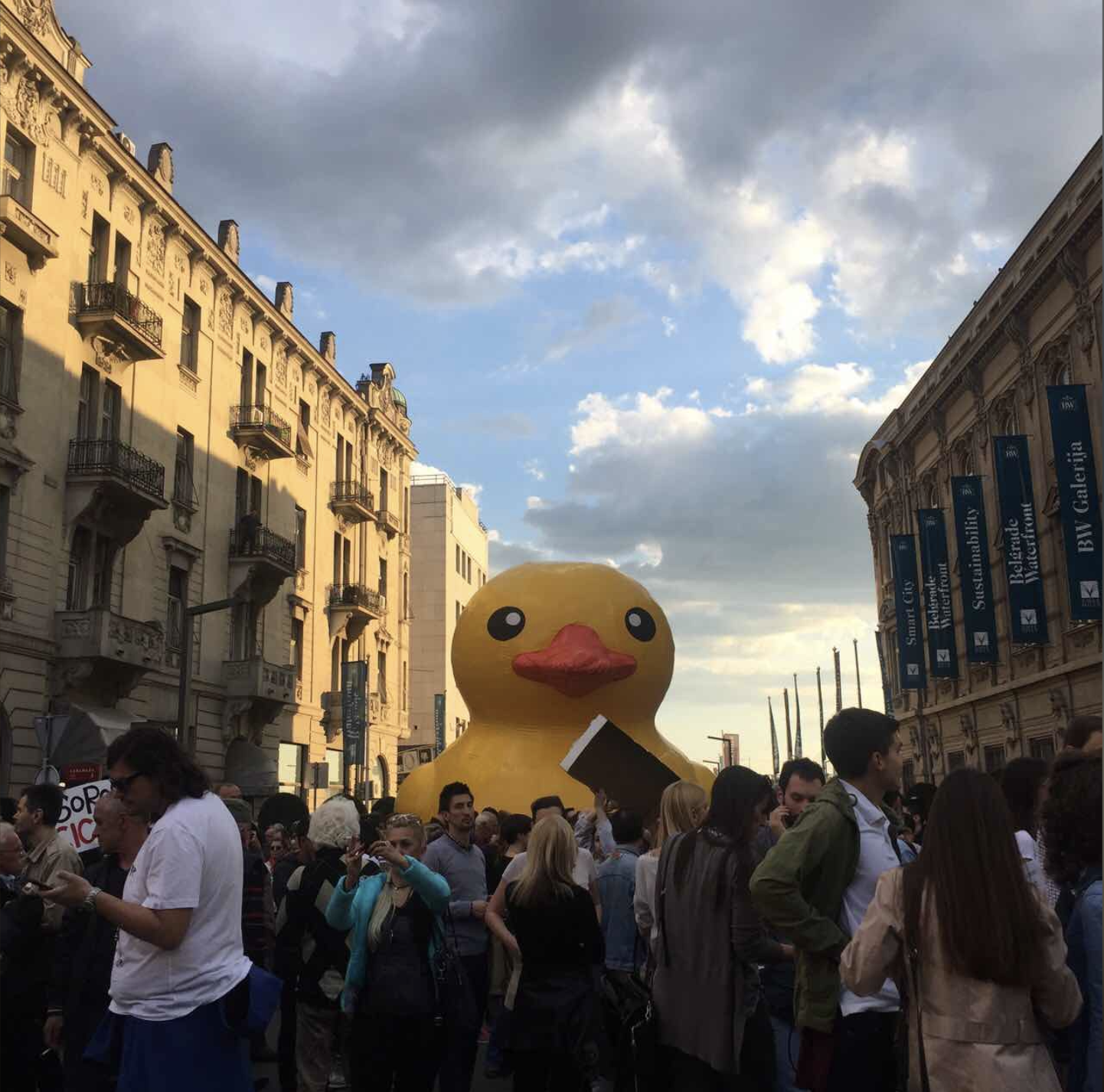
Protest in Belgrade, 2017
Source: Autonomija “You don’t start with a tactic. You start with why – and with who you’re trying to move.”
Protests are often the most visible face of activism. But just visibility doesn’t cut it. Across decades of social movements, one lesson appears again and again: movements win not because they are loud, but because they are strategic.
This distinction sits at the heart of the work of Srdja Popović, founder of Center for Applied Nonviolent Actions and Strategies (CANVAS) and a former leader of the Serbian student movement Otpor!, which helped unseat Slobodan Milošević in 2000.
Popović notes that tactics only work when they serve a larger strategy. Without that, even the largest mobilizations risk becoming what he calls “noise before defeat.” In our recent capacity-building sessions with civic leaders across Europe, Popović showcased how movements can move from symbolic protest to strategic victory.
Tactics only work when they serve a larger strategy. Without that, even the largest mobilizations risk becoming "noise before defeat”.
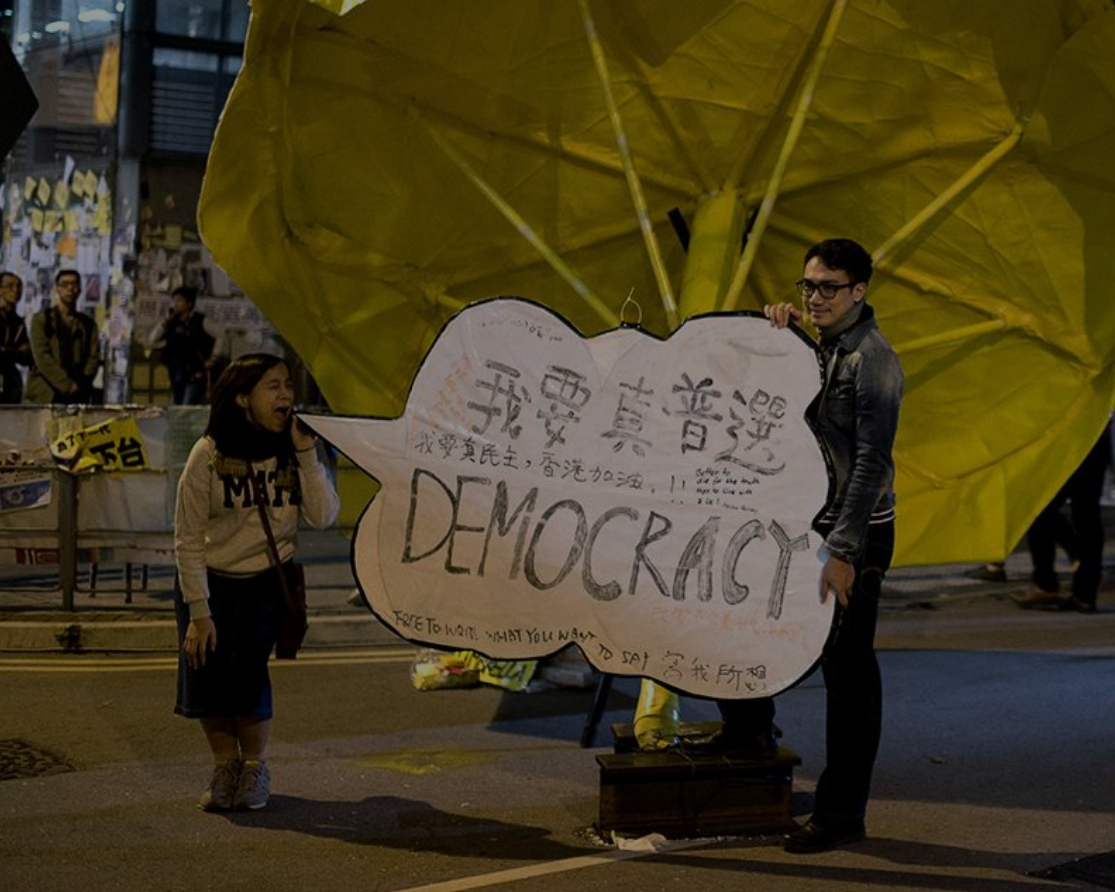
Source: Canvasopedia.org
Beyond the street: Strategy comes first
Movements often start with urgency – outrage, grief, fear, or moral clarity.
These emotions are powerful motivators, but they are not strategies.
Strategy begins by answering a different set of questions:
What exactly needs to change?
Who has the power to make that change?
Which institutions support the status quo – and which of them can be shifted?
Popović emphasizes that lasting change happens through institutions, not symbolism alone. Governments, courts, corporations, media, universities, religious bodies – these are the “pillars” that hold systems in place. Movements succeed when they weaken or realign those pillars one by one.
Some of history’s most effective campaigns succeeded because they targeted power with precision. The Montgomery Bus Boycott, for example, wasn’t just a moral stand – it deliberately targeted the economic viability of segregated transport, forcing political leaders to act.
You don’t start with a tactic. You start with why – and with who you’re trying to move, notes Popović.
Movements win not because they are loud, but because they are strategic.
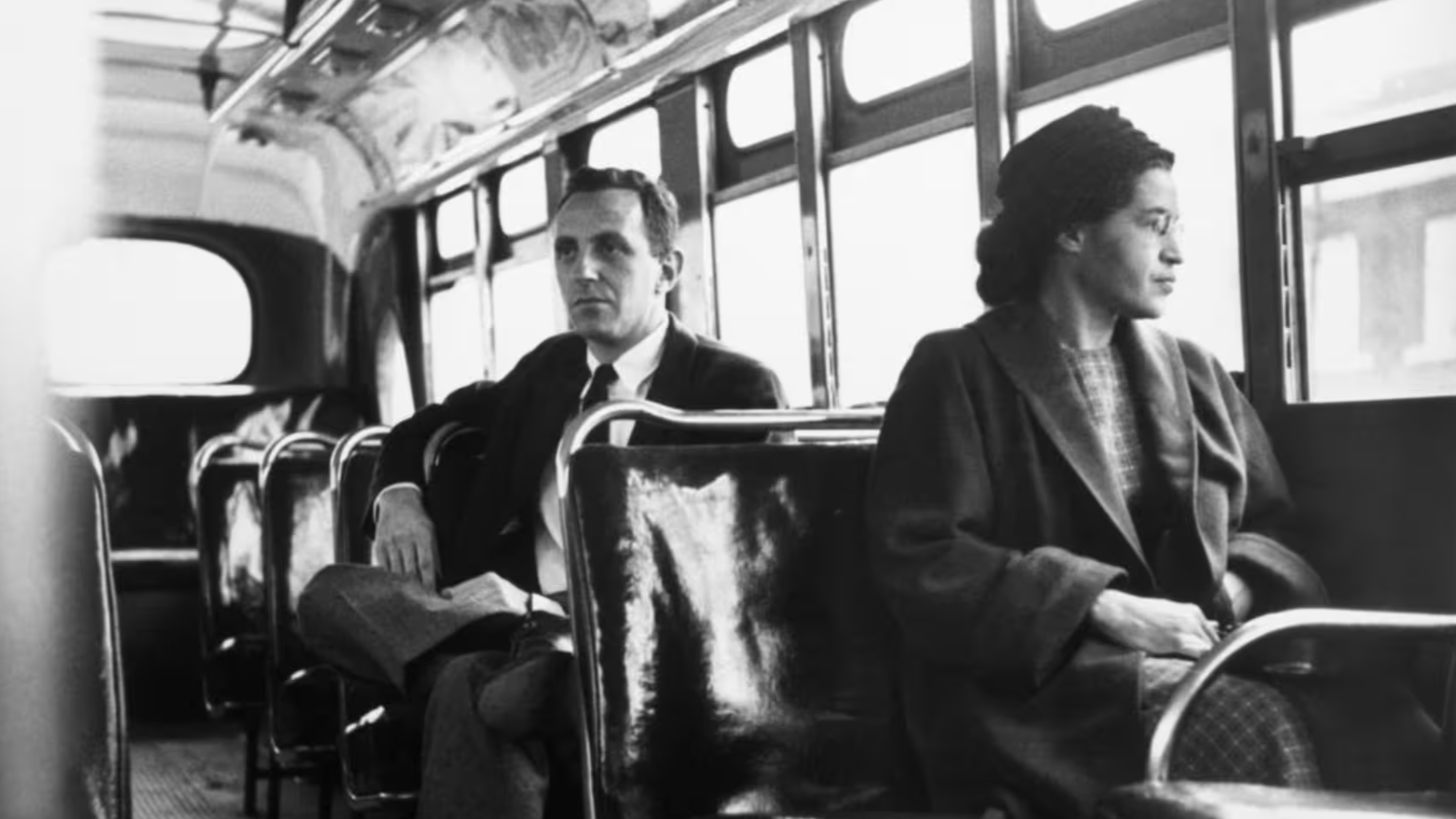
"The Montgomery Bus Boycott" – activist Rosa Parks sitting on a bus in Montgomery, Alabama, 1956.
Photo © Bettmann Archive/Getty Images
Source: History Channel
Not all tactics are equal
One of the most persistent myths in activism is that protests are the primary tool of change. In reality, they are just one option among the 198 documented nonviolent tactics, which can be grouped in three broad categories:
Protest and persuasion – Examples include: marches, petitions, symbolic actions
Non-cooperation – Examples include: strikes, boycotts, refusals, withdrawals
Nonviolent intervention – Examples include: sit-ins, blockades, occupations, parallel institutions
Each of these tactics serves a different purpose. Protests signal that something is wrong. Non-cooperation applies pressure. Intervention disrupts the system’s ability to function.
Crucially, movements fail when they use the wrong tactic for the wrong goal – or when they exhaust people through constant high-risk actions with little return. As Popović illustrates, a rally of 20,000 people represents tens of thousands of work hours – raising the question of whether that energy could be used more strategically elsewhere.
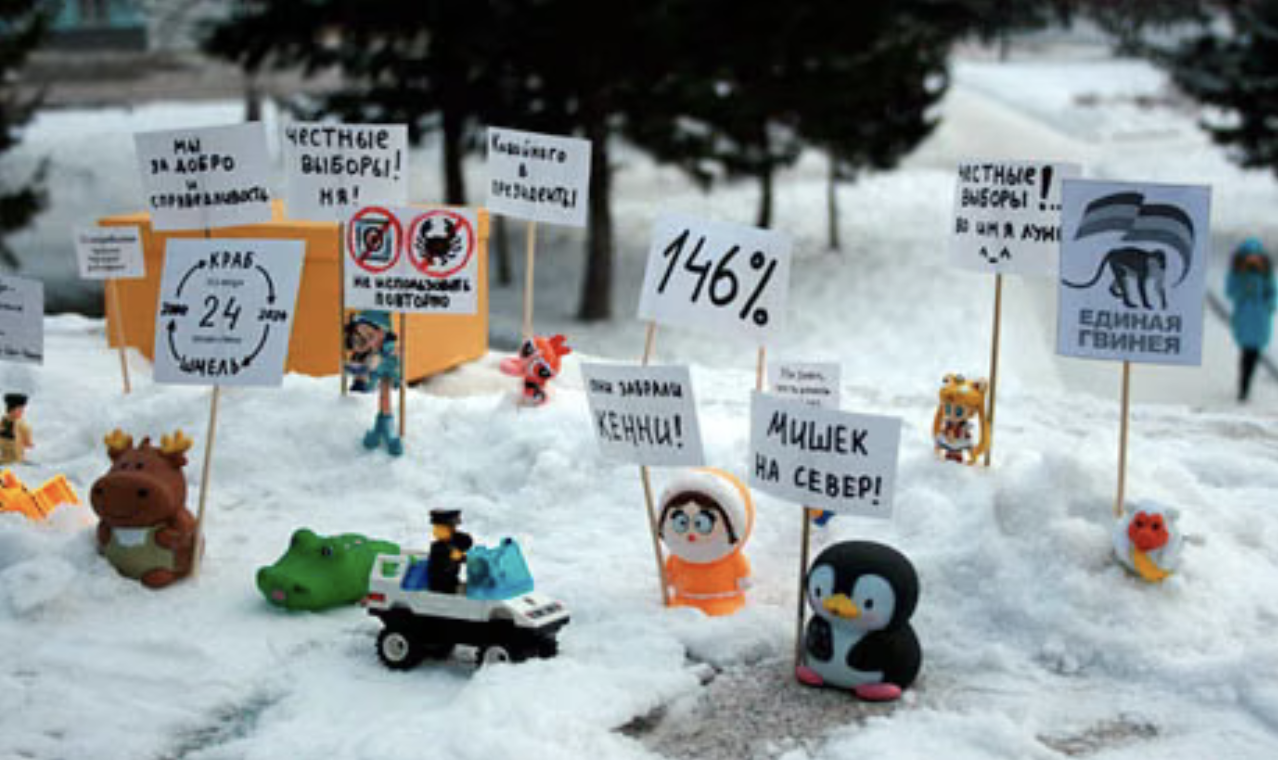
"The Toy Protest" in Barnaul, Russia, 2012.
Photo (c) Sergey Teplyakov/Vkontakte
Source: The Guardian
Creativity and humour as a strategic weapon
If strategy defines where a movement is going, creativity often determines whether people will follow.
Popović is a strong advocate of humour, and what he calls “dilemma actions” – tactics that force opponents into lose–lose situations. When authorities respond harshly, they look ridiculous, and when they don’t respond, they appear weak.
One famous example from Otpor involved placing a barrel bearing Slobodan Milošević’s image on a busy street and inviting passersby to hit it with a bat. Participants who put money into the barrel could strike it once, while those without money were encouraged to hit it twice. When police eventually intervened and ‘detained’ the barrel, the movement won the narrative instantly.
Research also shows that campaigns that use humour are significantly more likely to succeed – as humour disarms fear and lowers the barrier to participation.
“You can protest something deadly serious – and still do it in a way that makes you look human, creative, and confident.”
Creativity helps movements attract people beyond their usual circles, shift public perception, reduce fear of participation and make repression backfire. In short, creativity is not decoration – it is a form of power.
“You can protest something deadly serious – and still do it in a way that makes you look human, creative, and confident”
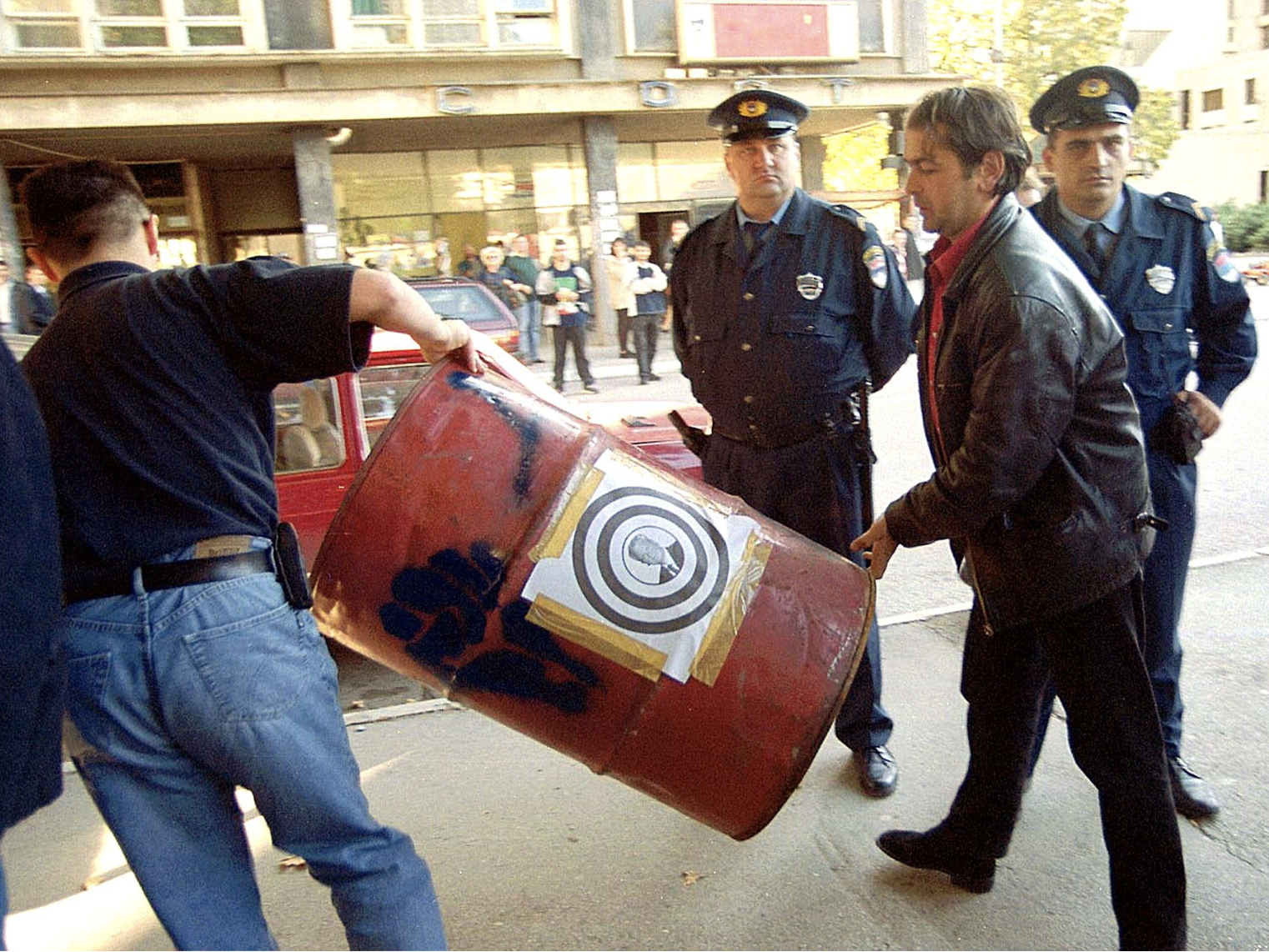
OTPOR (“Resistance”) – student protest in Uzice’s main square, 11 October 1999. Photo © Mzwele / EPA
Source: Tipping Point Magazine
Winning the middle, not the extremes
Another strategic insight Popović returns to repeatedly is the importance of “the middle.”
Movements are rarely defeated by their strongest opponents. They stall because they fail to engage the large group of people who are unsure, passive, or conflicted. Winning requires shifting what society sees as normal – so that the movement’s position becomes mainstream and resistance looks extreme.
This means avoiding tactics that feel satisfying to insiders but alienating to everyone else. “If you only act for the people who already agree with you, you will never win.”
Effective campaigns lower the participation threshold – making it easy for people to join without risking everything at once. A share, a refusal, a small public act, a visible sign of alignment. – momentum builds through accumulation.
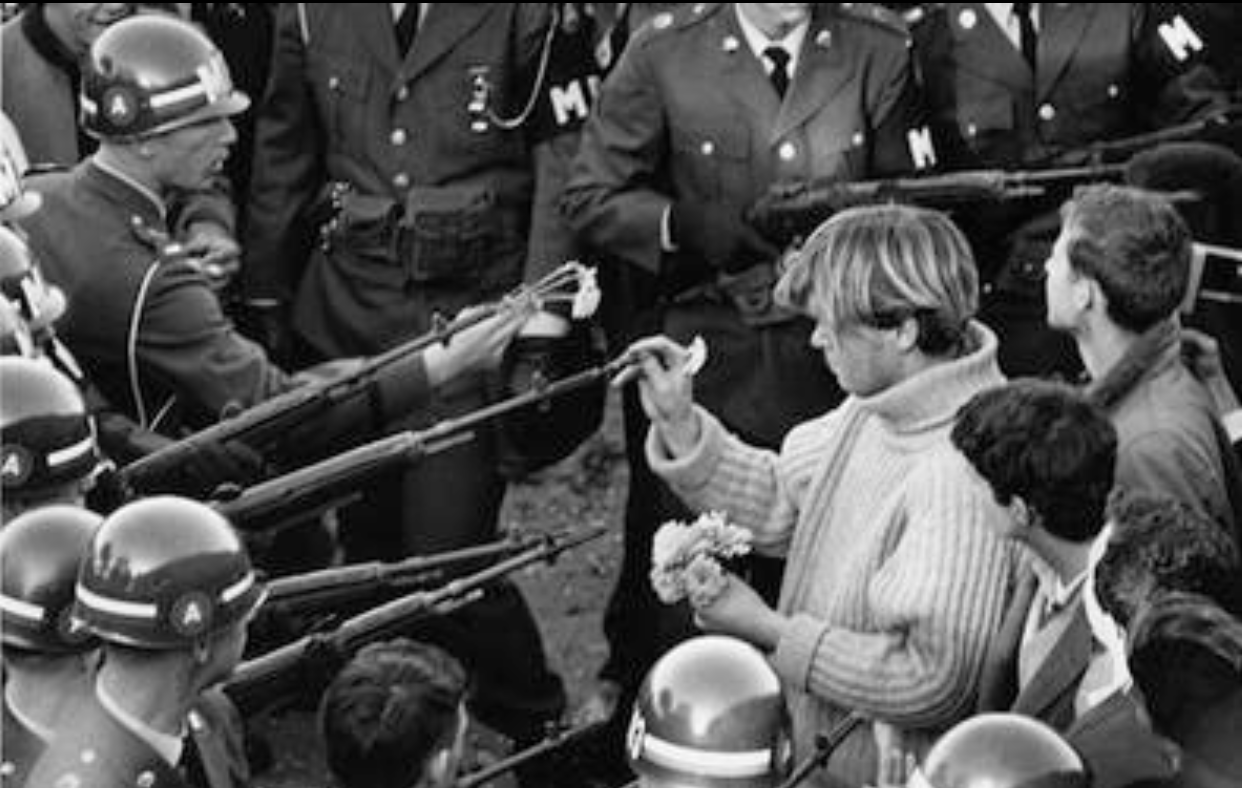
"The Flower Power", taken during the March on the Pentagon, October 21, 1967.
Photo (c) Bernie Boston
Source: Wikipedia“If you only act for the people who already agree with you, you will never win.”
What this means for organizations
For organizations working on human rights, climate justice, gender equality, or democracy, the implications are clear:
1. Start with strategy, not content:
Before designing campaigns, clarify the change you want, the institution that can deliver it, and the order in which pressure should be applied.
2. Choose tactics based on purpose:
Ask what each action is meant to do: mobilize supporters, recruit new allies, or disrupt power. If it doesn’t serve one of these goals, rethink it.
3. Treat creativity as infrastructure:
Humour, play, and imagination are not “soft.” They are tools for resilience, recruitment, and narrative control.
4. Design for the middle:
Avoid actions that harden divisions. Create entry points that allow people to step closer without immediately taking a side.
5. Measure success beyond visibility:
A successful tactic recruits people, shifts institutions, builds skills, or weakens opponents – not just impressions or attendance numbers.
Movements don’t win because they shout louder. They win because they plan better – and dare to be creative along the way.
Explore Tactics4Change, an interactive database of over 400 nonviolent dilemma actions from more than 100 countries, or Popović’s books Blueprint for Revolution on nonviolent techniques to galvanize communities, and Pranksters vs. Autocrats, on dilemma actions.
〰️
〰️

About Srdja:
Srdja Popovic is the Founder and Executive Director of the Center for Applied Nonviolent Actions and Strategies (CANVAS). In 1998, Popovic founded the student movement “Otpor!”, which played a crucial role in ousting Slobodan Milosevic. Popovic went on to found CANVAS, where he has worked with activists from 46 different countries, spreading the knowledge of the nonviolent strategies and tactics. Apart from being nominated for the Nobel Peace Prize in 2012, Popovic was listed as one of the "Top 100 Global Thinkers" of 2011 by Foreign Policy magazine. Popovic is the author of the books Blueprint for Revolution & Pranksters vs Autocrats.