The serious case for not being serious: The power of humour in activism
Illustration: Maria Krusteva for Fine ActsHumour is one of the most reliable – and most underused – ways that people connect with a cause.
Think back to the last time a movement or cause genuinely caught your attention. What pulled you in? A shocking image? A statistic that reframed everything? Outrage at something that felt wrong? Or, perhaps it was something that made you laugh?
Humour is one of the most reliable – and most underused – ways that people connect with a cause, and in the right hands, one of the most effective tools movements have. But let’s face it, most of us are a little scared of using it. The fear of getting it wrong and appearing to trivialize something that matters often keeps humour off the table.
Yet evidence suggests that fear is costing movements more than they realize. Activists who have studied and led nonviolent struggles consistently frame humour not as an aesthetic choice, but as a strategic tool. As Saul Alinsky put it in Rules for Radicals – one of the sharpest practical guides to organizing and movement strategy: "Humor is essential to a successful tactician, for the most potent weapons known to mankind are satire and ridicule."
“Humor is essential to a successful tactician, for the most potent weapons known to mankind are satire and ridicule.”
Illustration: Sa6ettu Fine Acts
Stop being so serious
Seriousness hands power a familiar script.
When protest follows a solemn and predictable form, authorities know how to respond. But satire and wit offer no such script – there is no clear protocol for responding to a well-constructed joke, and attempts to do so often amplify the very message authorities are trying to contain.Seriousness narrows participation.
Campaigns built entirely on urgency tend to mobilize those already convinced, while leaving others at a distance. Participation can feel emotionally heavy or demanding, especially for people new to an issue. As Alinsky puts it: "A good tactic is one your people enjoy. If your people aren't having a ball doing it, there is something very wrong with the tactic." Enjoyment is not superficial. It is what sustains engagement over time – and what brings people back and draws others in.Seriousness can reinforce the dynamics it seeks to challenge. Authoritarian power depends not only on force, but on being perceived as inevitable and untouchable. Even opposition can contribute to this perception when it treats power as something immovable and distant. Humour interrupts that relationship. When authority becomes the object of a joke, it is experienced differently – the sense of inevitability begins to weaken and what once seemed fixed begins to look surmountable.
Ridicule, as Alinsky argues, is difficult to defend against. It provokes disproportionate reactions. And those reactions, in turn, create openings.

The fear of getting it wrong and appearing to trivialize something that matters often keeps humour off the table.
Illustration: Jacques Kleynhans for Fine Acts
Enter Laughtivism
The term laughtivism was coined by Srdja Popović – activist, strategist, and one of the most influential thinkers on nonviolent resistance. In Blueprint for Revolution – described by the New York Times as a guide that "cheerfully blows up just about every idea most people hold about nonviolent struggle" – Popović describes laughtivism as the deliberate use of humour, satire, and wit as part of nonviolent struggle.
As one of the founders of Otpor! – a Serbian student movement that emerged in Belgrade in 1998 to challenge Slobodan Milošević's regime – Popović knows this from experience. Influenced as much by rock music and Monty Python as by political theory, Otpor! built its tactics around irony, satire, and accessible participation. One of their most well-known actions involved placing a barrel in a public space with Milošević's face painted on it and inviting passersby to drop in a coin and take a swing. When police intervened, they found themselves arresting a barrel – exposing the rigidity of the system more effectively than relying solely on formal demonstrations and contributing to a movement that would eventually lead to the regime’s downfall.
Popović later co-founded the Centre for Applied Nonviolent Action and Strategies (CANVAS), which has since trained activists across the Middle East, North Africa, and beyond. The lessons about the potential of laughtivism have spread:
Humour reduces fear – Often the primary barrier to participation in repressive environments. Laughter does not remove risk, but it changes how risk is experienced, making action feel more possible.
Humour helps movements grow – When resistance is associated not only with sacrifice but also with creativity and energy, this makes a movement feel irresistible.
Humour provokes reaction – Because authority tends to take itself seriously, it often struggles to respond effectively to mockery. Attempts to do so can appear excessive or clumsy – reinforcing the critique rather than containing it.
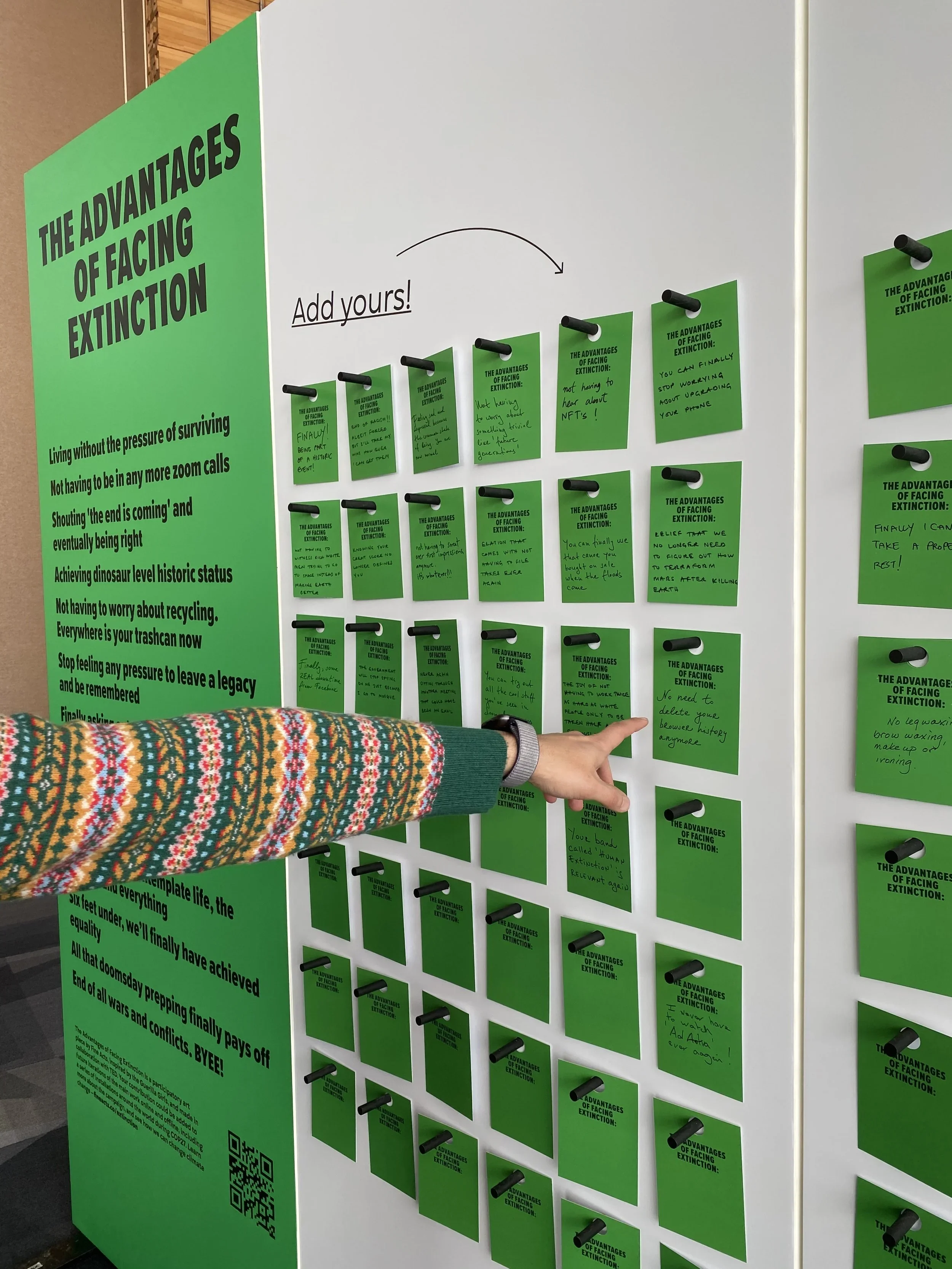
CASE STUDY: The Advantages of Facing Extinction – Fine Acts / TED 2022
Climate communications has a well-documented problem: the scale of the crisis often triggers paralysis rather than action. Fine Acts, a global creative studio for social impact, working at the intersection of art and advocacy, took a different approach.
The Advantages of Facing Extinction – first exhibited at TED 2022 – is a deadpan list of the upsides of human extinction. No more zoom calls. Not feeling any pressure to leave a legacy and be remembered. Finally being part of a historic event. There are SO MANY advantages of facing extinction. As an ode to silver linings, this piece ‘celebrates climate change ending it all’.
The joke lands, and then it opens something up: by listing the “benefits” of catastrophe with a straight face, the participatory installation piece sidesteps doom and makes space for joy and hope, inviting audiences into a different kind of engagement – ‘add why you’re excited about facing extinction’.
As Fine Acts put it: "Where there is fun, there is hope."
Photo: Fine Acts and Gilberto Tadday / TED
The idea of dilemma actions is simple: design an intervention so that whatever the opponent does, they lose.
Illustration: Tim Yarzhombek for ArtistsForClimate.org
The punchline is the trap
At the core of laughtivism is a mechanism Popović calls dilemma action – developed further with Penn State University professor Sophia McClennen in their 2023 book Pranksters vs. Autocrats, which analyzes over 400 such actions across different movements and contexts. The idea is simple: design an intervention so that whatever the opponent does, they lose.
Conventional protest gives authorities room to respond on familiar terms – disperse, arrest, issue a statement, wait for the news cycle to move on. A dilemma action removes that comfort entirely so that if authorities respond, they risk looking disproportionate or absurd. If they do not, they allow the message to circulate unchallenged. Either way, the movement wins the moment.
For example, in a city in Siberia in 2012, activists denied permission to protest found a workaround: they sent their toys instead. Teddy bears, Lego figures, and Kinder Surprise toys were arranged in the snow outside the town hall, each carrying tiny signs reading "A thief should sit in jail, not in the Kremlin" and "I'm for clean elections." The police officers were seen jotting down notes and details of the toy protesters, making for some fun and amusement among the city residents. The dilemma action drew a lot of international attention. More so, when the Russian prosecutors ruled that in the future, all such toy protests would be banned since the constitution did not allow for toys to hold public meetings, mass gatherings, or rallies. The ruling further emphasized that the toys had committed an illegal act by demonstrating since many of them were produced outside Russia, giving them a foreign status. As imported toys, they could not claim citizenship status. Moreover, the ruling pointed out (in all seriousness) that procedurally toys were not humans and hence, were not eligible to demonstrate in public places.
Illustration: Nikoleta Nosovska
The same logic runs through some of laughtivism's most celebrated examples. In Germany, ZDK Gesellschaft Demokratische Kultur – a democracy and civil society organization – transformed a neo-Nazi march into an involuntary fundraiser. Without the marchers' knowledge local donors pledged €10 for every meter marched to EXIT Deutschland, an organization that helps people leave extremist movements. The neo-Nazis marched on, unwittingly raising €10,000 for anti-extremism work, before being greeted at the finish line with confetti and a certificate warmly thanking them for their generous contribution.
In each case, the humour was not incidental. It was intentionally designed to create a situation in which power could not respond without reinforcing the message.
Two questions are worth asking of any planned action opposing a political or corporate entity. First: if the opponent ignores this, do we still win? Second: if they respond, do we win even more? If the answer to both is yes, the foundations of a dilemma action are already there.
“Humor melts fear and earns goodwill, often adding a “cool factor” to activism that draws support.”
Illustration: Gabriela Basin
Why humour works
The case for laughtivism is not just that humour makes activism more appealing. It is that humour works – as a way to reduce fear, attract participation, and create situations in which opponents undermine themselves through their own reactions.
For movements and campaigners, the practical implication is straightforward: if humour can influence who joins, how people engage, and how power responds, it can be used as part of how strategy is designed from the outset.
The role of wit and satire is to make a campaign or action travel – to give it the quality that makes people want to share it, talk about it, and show up for the next one. In contexts where power depends on fear, predictability, and distance, humour introduces the opposite: a sense that things could be otherwise.
Illustration: Katrin Kochorapova
Check out these resources!
“Pranksters vs. Autocrats” by Srdja Popovic, Sophia A. McClennen
Cornell University Press
”Blueprint for Revolution” by Srdja Popovic, Matthew Miller
Penguin Random House
Tactics4Change, a database of global dilemma actions created by Srdja’s org CANVAS